Your browser does not support .avif images. Please view on a modern desktop browser, released after autumn 2021. No apologies for not supporting Microsoft’s rubbish. View this page on the desktop mit Google Chrome from version 82, Opera from version 71, Safari from version 16.1, oder even better Firefox from version 93.
Intro
Why? – a “homecoming after fifteen years”

I lived in Tokyo for four years in the early 1990s and earned a living as a translator of technical Japanese. After 15 years, I simply wanted to see Japan again. In September 2010 – more out of curiosity – I walked into a newly opened travel agent that had Tokyo listed for just over € 700. I actually just wanted to ask “how much it would really cost” – with the usual “plus fees and taxes“ scam, I would have expected a thousand. [Nowadays included in the price by law thanks to “those useless EU bureaucrats”.] The lady then surprisingly said: I can do that for a hundred Euros less.
Unfortunately, I couldn’t pass that up; that’s cheaper than two weeks Canary Islands.
My budget was rather modest: ¥ 66,000 ¥ (625 euros; exchange rate 1 : 108) for two weeks (October 10–24, 2010). That’s a sum I’d recommend per day for someone unfamiliar with the country. In Japan, however, you always get value for money. Quality comes at a commensurate price. Japan has always been and still is very expensive, even if prices have barely increased in the last twenty years. Where I quote prices in ¥ in the text, simply convert 1 : 100 (so 1 cent = 1 ¥). [As of 2022/3 the Yen had fallen to 1 : 150–160 making Japan almost a cheap destination. Inflation in 2024/5 and a rate of ¥ 140 per Euro caused a ten percent uptick. Under these circumstances travel is no more expensive than in a Western European country, alas one can still spend a fortune on accommodation.]
I spent: 17,500 ¥ for long-distance buses, about 7,000 for local transport, 5,000 for overnight stays, 11,000 for souvenirs, 5,000 for entrance fees. The rest was for snacks, food and drinks.
Note: in 2025 one Euro was worth only 70 % of what it had been in 2010. Insofar Euro prices are quoted below they should be multiplied by 1.42 to adjust for inflation.
… we entered our beloved Japan with a certain amount of skepticism – because shortly before [2008], the country had significantly tightened its security regulations for visitors. A digital photo is taken of each incoming passenger and the fingerprints of both index fingers are also scanned. With such procedures, the Japanese – as so often in recent history – followed the behavior of our American friends. However, given the extreme security of the island nation (and its minute foreign population (2020: 1,78 Millionen without ethnic Koreans left over from the war, equal to 1,41 % of the total)), such checks have a decidedly grotesque character right from the start. I must also say that people like me – who, moreover, are entering from a friendly country – are quite offended by such developments.
In Kyoto, I met a Swiss guy who happily explained to me that he had stayed in a business hotel for “only 300 francs” [€ 290] (including breakfast). He was a bit offended when I told him that I was staying for € 11 (including breakfast). My place wasn’t a dump, though; the showers were one floor down, but otherwise - like everywhere else in the country - spotlessly clean. But you only get something like that if you know your way around a bit. I won’t claim to speak Japanese anymore - broken language was a better description for the first week, at least. I can still read well enough, though.
Off to Tokyo

During the four years I lived in Japan, I almost never left Greater Tokyo. Whenever I had time off, I immediately went to Narita Airport (NRT), then and now one of the worst airports in the world and headed to Southeast Asia.
For workers around the capital, a one-way commute of 1½ hours is considered normal. When one takes into account that the Japanese high speed trains, the Shinkansen,  travel at an average speed of 200 km/h, it is easy to calculate how large the catchment area is. The Tokyo metropolitan area oof 23 wards has approximately 13 million inhabitants; including the surrounding region, which is the Kantō Plain, as defined above, the population is approximately 23-25 million, or one-sixth of the Japanese. Commuting costs in Japan are fully borne by the company. Driving makes little sense due to the lack of parking spaces. Added to that are a few nasty inconveniences, such as the requirement to provide proof of a parking space within 500 meters of your home and the vehicle tax: cars over 2000 cm³ or wider than 1.70 m, i. e., practically all European imports, fall into the exorbitantly expensive tax bracket 3.1 Driving is on the left. Almost all motorways are toll roads with maximum speeds of 90-110 km/h.
Based on television reports, there is a persistent belief that Japan’s big cities are primarily home to high-rise buildings. This is totally false (although builders love concrete!). Only in a few geologically stable, confined locations in major cities can skyscrapers be built on bedrock. In Tokyo mainly in the district of Shinjuku. Urban highways on stilts are very popular. They increase the profits of construction companies. Public procurement is an extremely corrupt affair, with construction companies being big supporters of the various factions within the long-serving ruling LDP (Vgl. Politische Korruption in Deutschland und Japan, Uni Konstanz 2008) party (which even the CSU [party of the conservative right (law-and-order populists) in the state of Bavaria, almost uninterrupted in power since 1949] could still learn from). Most buildings in Japan generally fall into the category of hideous slabs of concrete, 
View from Yoyogi-kōen in Tokyo, on a “car free” Sunday 1991. something I try to remove from my photos as much as possible.

It’s also worth noting that centuries of earthquakes and fires have taught the locals not to build for eternity. A house is built (traditionally, until the 1970s from wood), considered old after 30 years and torn down. No maintenance (painting) is performed in between.
What has changed?

I returned after fifteen years. The first apartment building (in Setagaya-ku) I’d lived is now a parking lot. When I looked for the second house, I couldn’t even remember where it had been – the main street had been widened and all the surrounding buildings had been replaced by new buildings (4-5 story steel-frame structures).
These new buildings have one drawback: every apartment has a bath [Note: bath/shower and toilet were always separate rooms in Japan]. As a result, fewer and fewer people are using the public communal bath (sento; ¥ 400, prices set by the city), one of the great achievements of Japanese culture. I went to five different ones on this trip and enjoyed all of them, even if they were often more of a retiree hangout. (As a foreigner, you always get a bit of a strange look at the entrance. Does gaijin (“foreigners”) even know how to wash himself properly?)
What has changed? Little; prices have remained almost unchanged. [In Japan, there has been hardly any inflation since the beginning of the economic crisis in 1989. Based on 1995, the general price index for 2019 was 104.5. This means that the prices given here have only increased slightly. However, the value-added tax (VAT) was raised from 3 % to 10 %. Smaller shops and restaurants, in particular, do not include it in their prices, but only add it at the checkout. At the same time, the Yen has fallen against the euro. Starting at an exchange rate of 1 : 130, Japan is barely more expensive than anywhere else in Central Europe.] [Since 2023/4, the Yen has been even cheaper at 150+ per euro, although there has been more inflation since Corona.] First of all, there is paper in public toilets. One is no longer dependent on the “samples” with advertising handed out in front of subway stations. Prussian naval cadet-style school uniforms for boys became very rare and the associated mandatory 2 mm haircut seems to have disappeared completely (probably due to former Prime Minister Koizumi’s unconventional hairstyle). Cigarettes cost twice as much. I haven’t seen (or rather, heard) the  “sound trucks” of the Ultra-Nationalists that used to blare on every major train station forecourt with their lunatic-fringe messages – they’re not completely extinct yet. [Like in many “democracies” right-wing opinions have entered the political mainstream over the last two decades. During the 2010s the party Nippon Ishin no Kai gained a large following. UKIP would be the British equivalent.])
What remained unchanged? First, the pleasantly unobtrusive police officers with their exquisite courtesy – as long as you’re not in the cell, then things get extremely unpleasant: 23 days incommunicado are legal. They have their own “way to make you talk!” (人質司法, literally “hostage justice”) is a term used to describe Japanese law enforcement practice. Victims of the Japanese justice system use this term to describe the strategy of prosecutors to keep suspects in custody like hostages, e. g., by re-arresting them immediately after the expiration of the statutory period on a slightly amended charge in order to extract a confession. Without this “ransom,” release on bail pending trial is almost impossible. The conviction rate in Japanese courts is over 99 % (compared to 68 % in the US in 2018), 89 % of which are based on confessions. The principle here is: “In case of doubt, against the accused.” Detailled in: Strafprozeß und Staatsanwaltschaft in Japan)
The cleanliness and absolute correctness in business life (tips are not accepted and absolutely nothing is stolen except umbrellas and bicycles). Seafood and fish is always fresh.
The shop opening hours are pleasant by European standards: while the numerous mom-and-pop shops still close at 6 p.m. sharp, large stores stay open until 8 or 10 p.m. and close one day during the week. Furthermore, there is a convenience store (Nationwide chains are Lawson, Family Mart and 7-11.) in every neighborhood that is open 24 hours and offers absolutely everything for daily needs (including soft porn) at only slightly higher prices.
What is missing?


First and foremost, peace (silence). There’s always some announcement playing or something beeping. Japanese gardeners don’t do lawn (outside golf courses). Where there are parks, the ground is usually plain dirt. There are still no trash cans or seating in public spaces. I agree completely with Christoph Neumann and his book „Darum nerven Japaner“ (ISBN 978-3-492-24508-1, € 7) [“Why Japanese are annoying”] and won’t repeat them here. More on that in the section Curiosities.
Social security: Western reporting usually ignores the fact that social secuity (“welfare state”) is almost non-existent in Japan. Homeless live in parks2 because dole money (approx. € 200 in the 1990s) is paid only to those with a fixed abode. All child-birth related costs must be born by the parents (ca. 3000 € [as of 2026 to be born by the National Health]) because giving birth is “not a medical condition.” The co-payment for doctor’s visits for those with National Insurance is 40 %. Government pensions begin at a retirement age of 70, but as a permanent employee in a large company, workers are forced out of their job at around 55. They are given a severance pay equivalent to two to three years salary. I always found this to be a disgrace; after all, Japan isn’t a third-world country.
Shitennō-ji, Osaka
To Osaka
Since I hadn’t bought a Japan Rail Pass – one of the few good deals in the country – I took the long-distance bus to Osaka, which is somewhat unusual. While it’s a good seven hours journey overnight, the buses (about half the price of a train) pleasantly surprised me. In contrast to the Shinkansen, where if you’re over 1.80 m tall you’re pretty squashed in (à la Ryanair), there are only around 25 seats, three in a row. They also provide a pillow and blanket. All would be good business class, if it weren’t for the recorded announcements at every stop …
It goes without saying that a bus scheduled to arrive at Osaka-Umeda at 6:43 a.m. after seven hours will arrive at 6:43 a.m. and not 6:41 a.m.! But Mussolini – in his time trains were said to have run on time in Italy – was, as we all know, an ally of the Japanese, who learn a lot from other countries.
Osaka, formerly Naniwa, is nothing more than another ugly Japanese city. I only stayed there for one day to visit the Shitennō-ji.


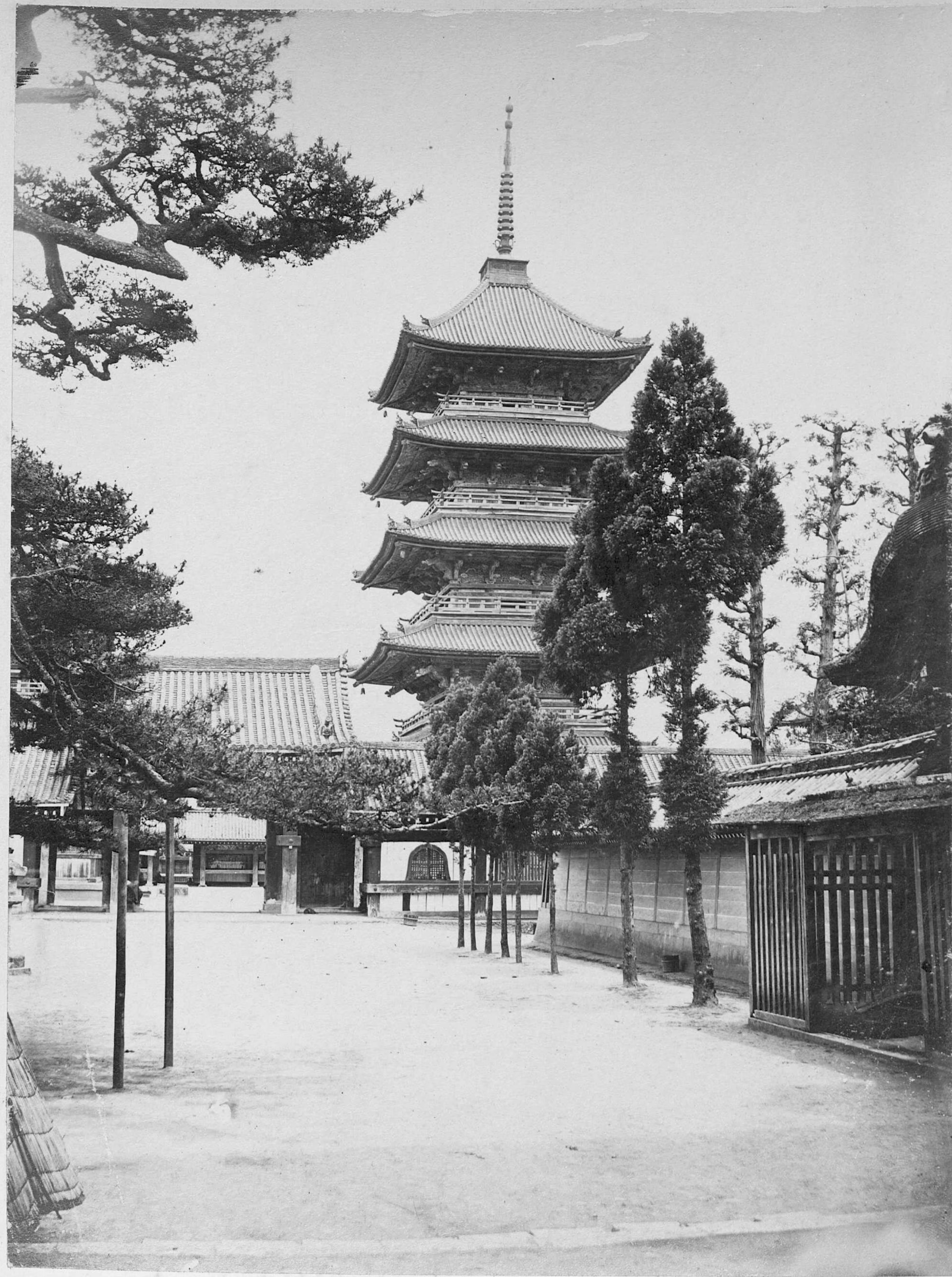
This “Temple of the Four Heavenly Kings,” nowadays belongs to the esoteric Shingon sect is sparsely visited and quiet compared to the crowds that frequent temples in Nara and Kyoto. It is said to have been founded by Prince Regent Shōtoku Taishi in the 7th century. The complex has been repeatedly rebuilt after fires and other disasters, staying close to the original plan based on Chinese models. The renovated, current complex was completed in 1963. The traditional Four Heavenly Kings (Skt.: Catur-mahārājas or Lokapālas, of which there are Vaiśravaṇa, Virūpākṣa, Dhṛtarāṣṭra, Virūḍhaka.) of Indian cosmology have been given a Japanese interpretation. In addition to the sect’s founder, Kūkai, there is Saichō, both bringers of esoteric Buddhism and teachers in the early 9th century in addition to the Buddha and the Prince Regent. The pagoda is considered the oldest surviving one in Japan; in fact it, too, has been rebuilt several times. In the 20th century alone, the Muroto Typhoon in September 1934 and subsequent American air raids caused severe damage. Repairs were completed in 1959. Since then it has a core made of reinforced concrete. Only one ancient building survived from the ancient period undamaged.5
Arima-Onsen

Arima-Onsen: How to concrete over a river properly?
An onsen is nothing more than a place with (usually) hot (mineral) springs, which are abundant in Japan due to volcanic activity. There are usually springs that are open to the public like a public bath (sento). Others are freely accessible as foot baths or enclosed for drinking water. Their symbol on maps and signposts is ♨️.
These days, they usually offer a steam room/sauna and various pools with bubbles, etc. It’s similar to a better German indoor pool (which are almost nonexistent in Japan), only on a smaller scale. These places also have hotels that sell one- or two-day trips for stressed-out Japanese, typically in groups and all-inclusive and that offer their own luxuriously equipped pool areas. This also includes the inevitable drinking session on warm sake (rice wine with about 13-15 % alcohol). The bottle is allowed to float in the pool to keep it warm.


The sulfur springs on the slopes of Mount Fuji (please don’t say Fujiyama!) are famous. There, one can even hard-boil eggs, which then have the proverbial smell of rotten eggs – a truly wonderful souvenir.
A quick word about souvenirs, called o-miyage in Japanese. It’s an unavoidable obligation – even on the shortest trip – to bring a small gift back to relatives, friends and colleagues. This is to apologise for having “enjoyed” oneself on a trip. In every town (and in every temple), there are stalls or shops offering “local” specialities (which vary little from place to place), such as dried fish, sembe (rice cakes), filled moji rice cakes and the usual tourist knick-knacks.
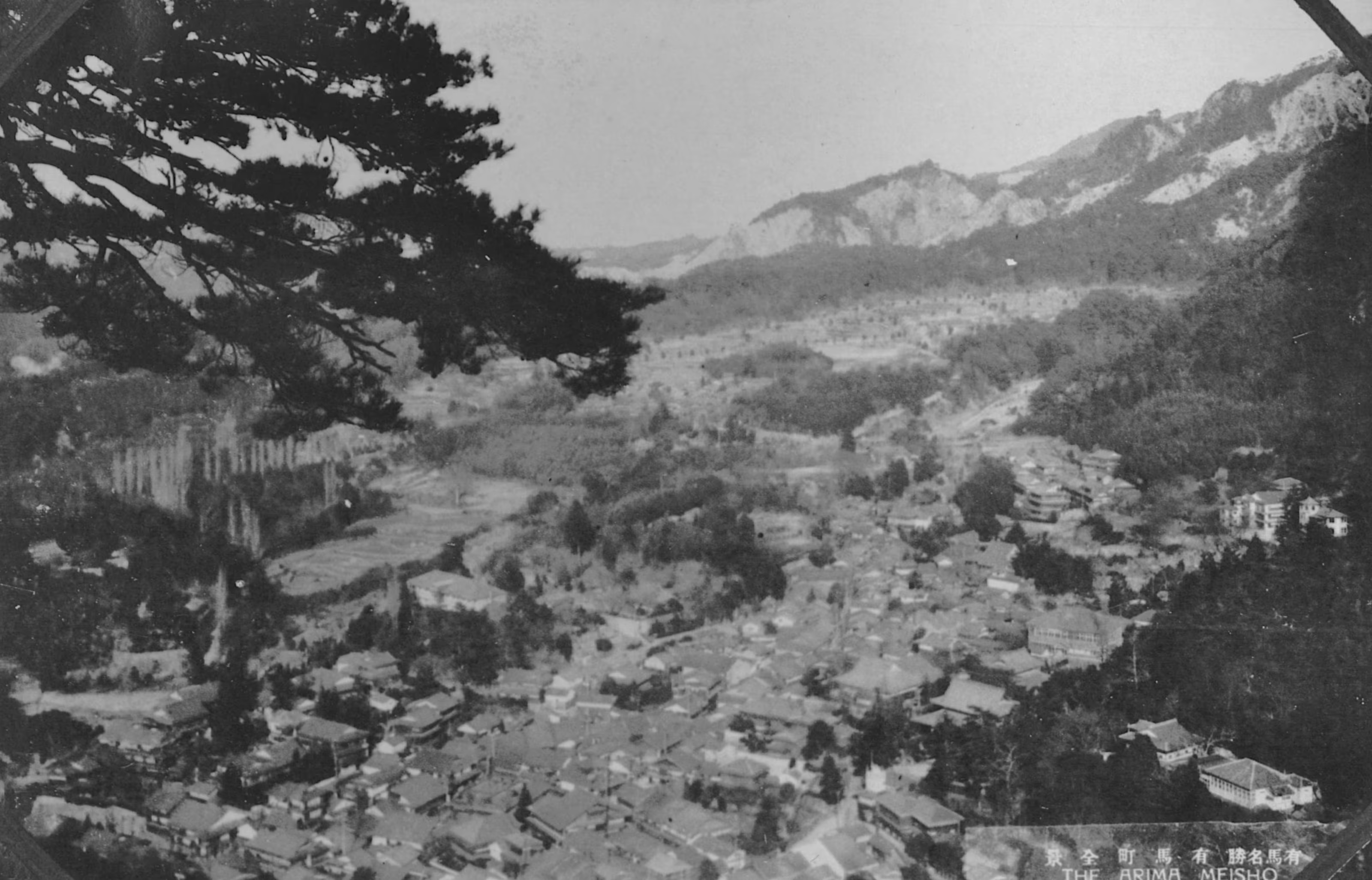
Arima-Onsen town (有馬温泉) is located behind the Rokko mountain range at an altitude of about 500 meters. This was the favorite spa of Toyotomi Hideyoshi, (second unifier of Japan, 1537-98) who is also commemorated with a monument. In the town center his foot bath is nowadays public. One can simmer one’s feet in a 43 °C brownish broth. A cool spring in a small park is naturally carbonated and truly delicious. On the outskirts of the town is Zuiho-ji Park, resplendent with an unusually high number of mushrooms, which are not collected for consumption in Japan.
Mushrooms


Part of the Japanese belief in the uniqueness of their country is the obsession that Japan is the only country with four seasons. I was a few weeks too early for autumn, with its often truly magnificent deciduous trees (especially Acer japonicum .avif) ). Daytime temperatures on the coast were still well over 20 °C.
). Daytime temperatures on the coast were still well over 20 °C.
However, there were mushrooms in parks and along the roadside—without having to search for them—in a variety I hadn’t seen in Europe. In Japan, wild mushrooms aren’t collected for eating. The friendly Chinese-Japanese family who showed me the way to the foreign cemetery was downright horrified when I suggested making a meal out of the bay bolete  (Imleria badia) by the roadside. It’s worth bearing in mind that up until then, none of Japan’s numerous nuclear power plants, which are primarily built on geological faults, had exploded (although at least the Monju nuclear reprocessing plant came pretty close—more than once). [The Fukushima disaster occurred about six months after my trip.]
This isn’t to say that the Japanese don’t eat mushrooms. Quite the opposite. They only eat cultivated mushrooms, such as Enoki, 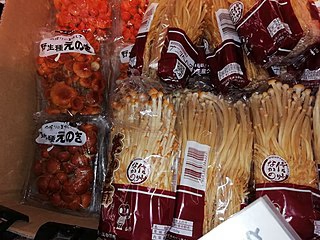
Enoki (エノキ) on display in a shop. Left the brown “wild“ variety. On the right the thin white cultivated kind. dried morels (from China), or the extremely expensive matsutake. 
Matsutake (Tricholoma matsutake) on special. 10 for only 280 Euros. The latter are almost all imported from evil, evil North Korea, a fact that is discreetly kept quiet.
Museums
The otherwise sleepy town is worth visiting for its museums. One is the modern photography museum in a beautiful new building; I didn’t go inside. Then there’s the four-story “Arima Toys and Automata Museum.” It’ top floor filled with German tin toys from before 1950. It also features some robot dolls from the Edo period. The 900 ¥ entrance fee was well spent.
Somewhat hidden away on a hillside is the “National Philatelic Museum“ (500 Yen; Philatelic Culture Museum), in a traditional one-story house with old mailboxes in front. You take your shoes off at the entrance; there are essentially two large rooms, one with general (international) postal history and one displaying all the Japanese stamps ever issued. This is of interest to collectors, as numerous forgeries of the 19th-century issues exist. I found it amusing that the only other visitor – a Japanese man – came up to me as I was looking at the world’s first stamp, the English 1 penny from 1840 and pointed out in Japanese that it was the world’s first stamp, his body language intended to convey HOW great that was. When I replied “sh’teru” (“I know”), he walked up to the cashier in dismay and said something like, “that gaijin can even speak Japanese!?”
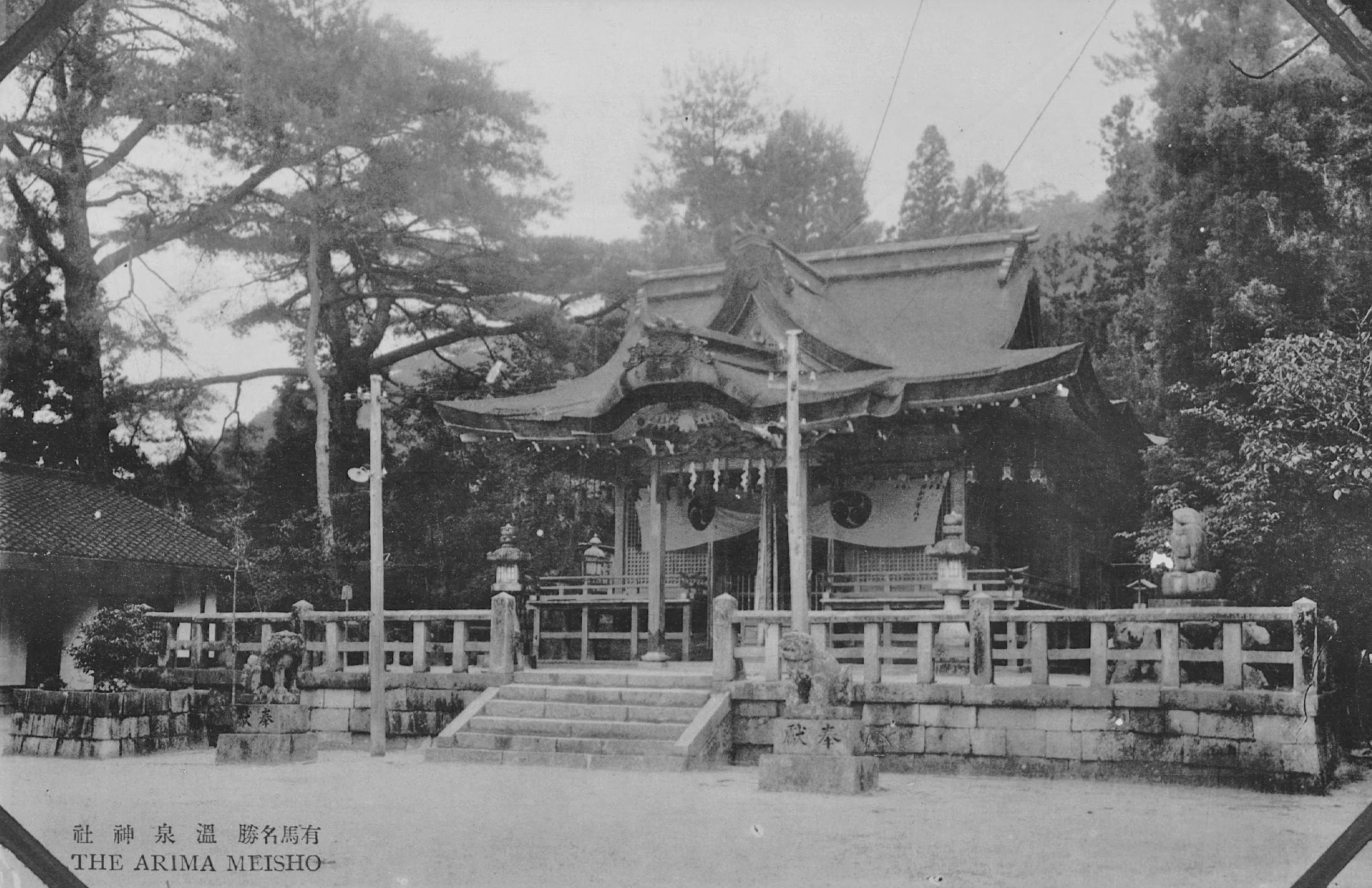
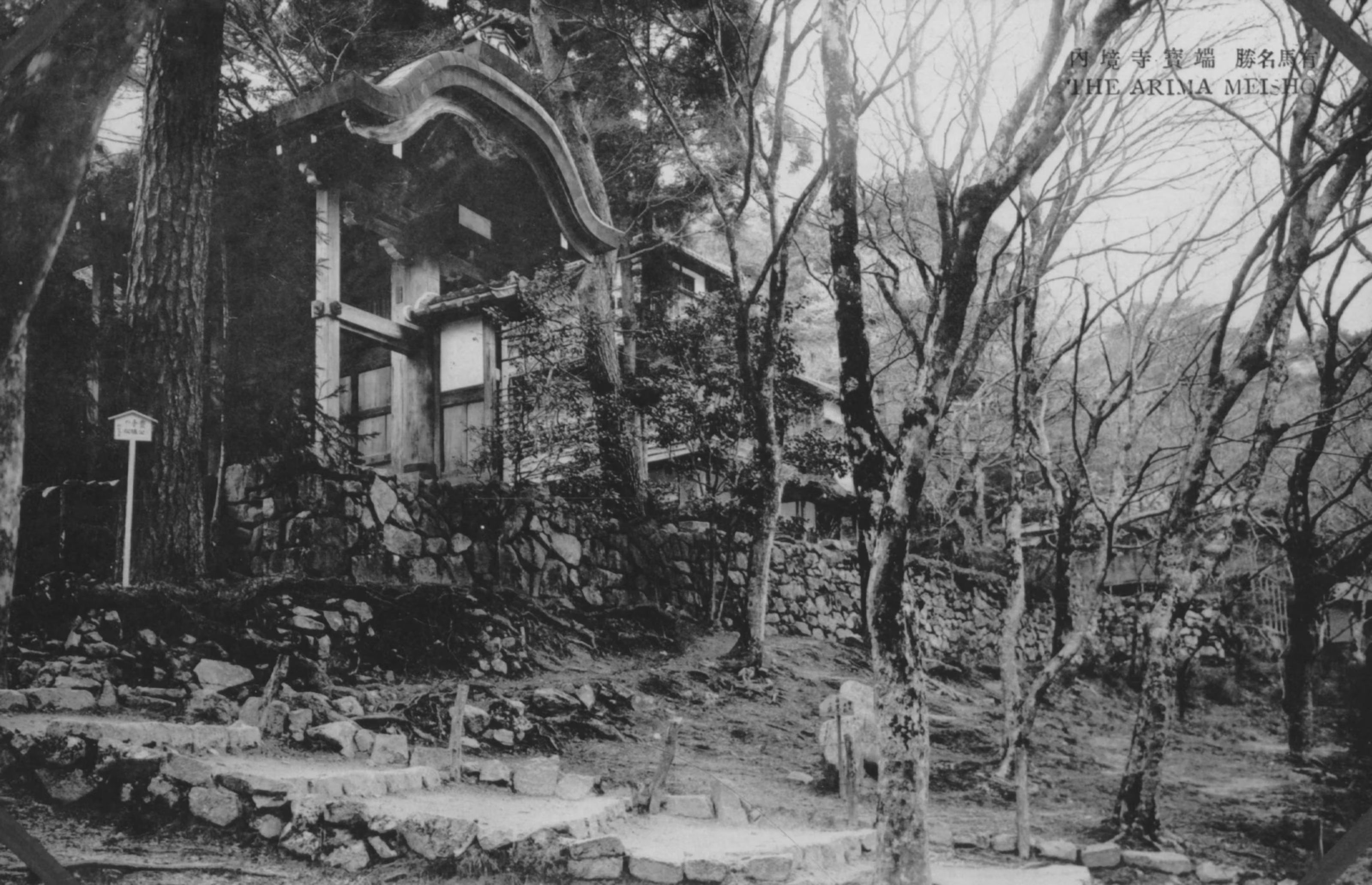
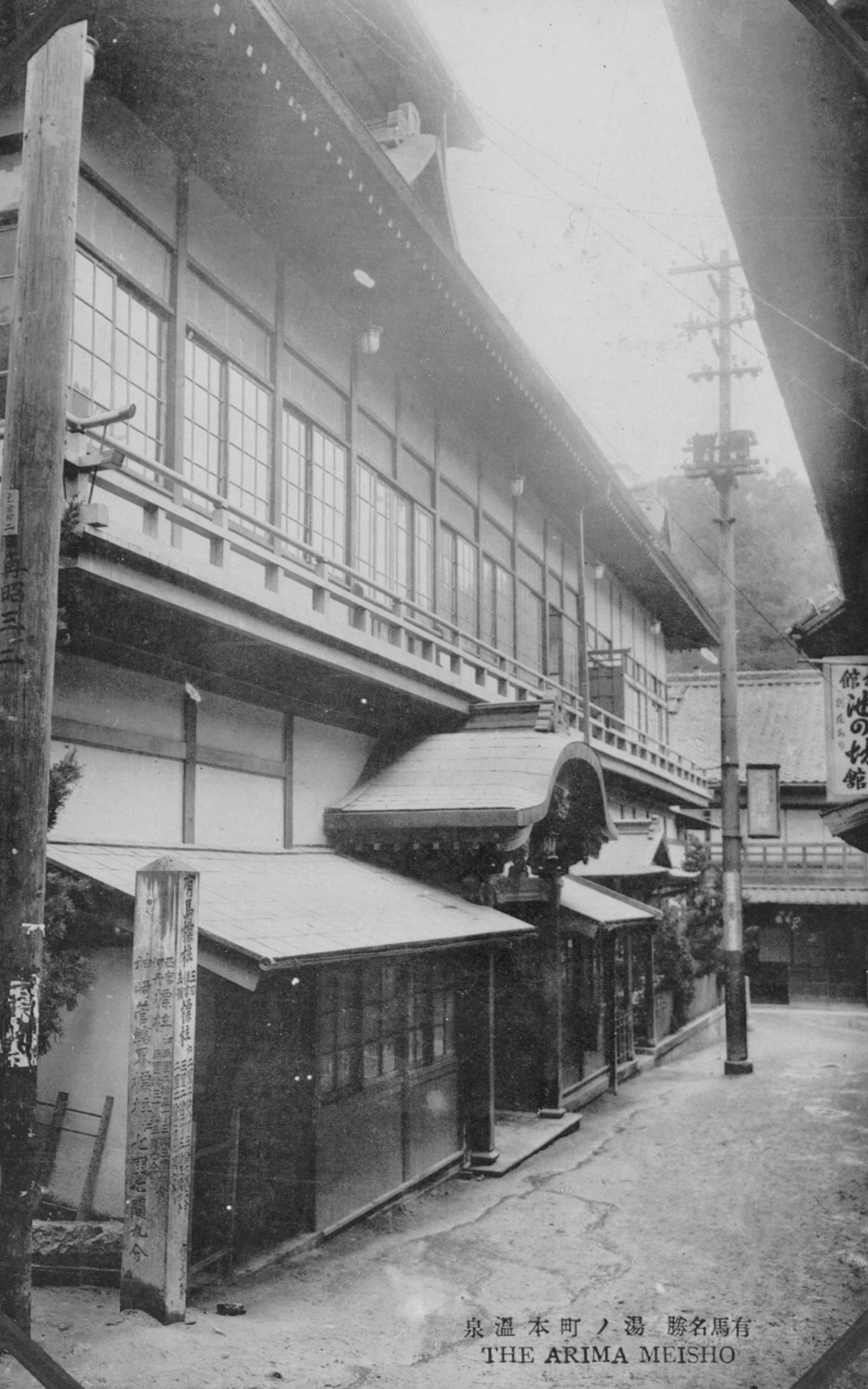
Arima early 1930s 
Nara

In Nara, I spent three days touring temples. However, unlike Japanese tour and school groups, I limited myself to two per day. For the most part, one can wander freely around their complexes; the main building, through which you’re herded in groups every three minutes, costs around 400-500 ¥, as does a well-kept garden and, if there’s one, the museum, for which the charge is ¥ 700-1000. Since there are no combination tickets, this quickly adds up, especially if you want to buy postcards or devotional items. (Jesus drove the money changers out of one temple; in Japan, he would never have been finished in time for the crucifixion …). To be fair, it must be mentioned that the Constitution of 1947 prohibits the state from spending public funds for religious purposes. Sects and temples must finance themselves entirely. [But are exempt from income tax.]
Der Kansai Thru Pass,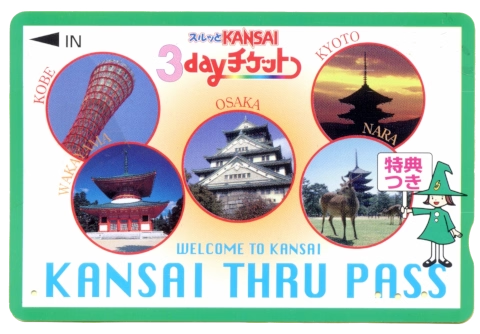 available only to tourists (passport with “temporary visitor” entry stamp required) at the region’s tourist offices. One of the few bargains in Japan – three (even non-consecutive) calendar days of free travel on all non-JR, private train and bus lines.
History
Nara, then called Heijokyō, was chosen as the permanent capital under Emperor Gemmei in 710. It remained the imperial residence until the death of Empress Shotoku in 794.
The new capital was the first true urban center in Japan. It soon had a large population. While the figure of 200,000 inhabitants, or almost 4 % of the country’s total population, assumed by scholars in the early 20th century is today considered too high. Probably 80,000–100,000 residents seems realistic. Approximately 10,000 officials held positions at court. A sophisticated system of administration and laws, the so-called Ritsuryō was introduced and remained the basis of Japanese law to the 1860s.
Economic and governmental activities increased during the Nara period. Roads connected Nara with the provincial capitals, taxes were collected more efficiently and regularly. Coins were minted, though not widely used. There was little trade outside the Nara area. In the provinces, the old system of land tenure, established as part of the Taika Reform of Prince Regent Shōtoku (Do not confuse Shōtoku Taishi † 622 und Empress Kōken, also called Shotoku † 770 during her second tenure.) faded.

The town houses important surviving early Buddhist temples of the six Nara sects. Like everything in Japan, however, most of them were destroyed by fire and rebuilt several times over the centuries.
The present-day city lies somewhat east of the old capital, whose palace area remains undeveloped as an archaeological site. Several replicas were erected there to commemorate the 1300th anniversary. The court in Nara aggressively introduced civilization based on the Chinese model. For this purpose, diplomatic emissaries were regularly sent to the Tang court. Ordinary Japanese were not allowed to travel abroad. Foreigners were permitted entry and exit only through the port of Hakata in the Dazaifu Special Military Administrative Region in northern Kyūshū. This authority strictly controlled trade and attempted to prevent contact between foreigners and locals as much as possible.
Tōdai-ji
The "Eastern Great Temple," whose construction began in 733, is a UNESCO World Heritage Site. The main hall contains the monumental bronze statue of the Buddha Vairocana, the Daibutsu of Nara, which has been frequently repaired.
Emperor Shōmu wanted to rule an empire governed by the principle of harmony and Buddhist law. A devastating smallpox epidemic from 735 to 737, which wiped out a quarter to a third of his subjects, prompted Shōmu to establish state monasteries and convents with large Buddha images in every province. A monumental Buddha image was erected in the Great Temple of Todai in Nara as an
earthly symbol of Buddha’s heavenly tranquility.
The fifteen metre high figure of the meditating Vairocana (“shining”) was made from 450 tons of copper [bronze]. According to historical records 50,000 carpenters and 370,000 metalworkers were required for its construction. Hills had to be levelled for the site. The wooden building erected around it dominated the landscape for miles.
Fires destroyed the huge hall twice, the statue was rebuilt several times. Today, only the lotus petal base remains from the original.
Nara and Tōdai-ji




Kofuku-ji
The first major temple from the station is Kofuku-ji, still the main temple of one of the oldest Buddhist sects, the Hossō, to which Kyokai also belonged. He is the author of the Nihon Ryōiki, the oldest surviving collection of Japanese Buddhist legends, so-called setsuwa literature. It was completed before 822. It’s still worth reading today, as many of the 105 stories demonstrate how little humanity has evolved: Greedy robbers and murderers, extortionate officials and idiotic policemen were no different then than they are now.
The temple is famous for its two pagodas, one three-story and the other five-story and its numerous preserved ancient exquisite carved statues.
Kasuga-jinsha
Shintō is Japan’s native religion.3 In shrines (jinsha) the “kami” (deities, or more accurately “the divine”) are worshipped. For over 1,200 years since the introduction of Buddhism, a syncretism between the two faiths developed. It was not until the early Meiji period, when the new rulers broke the dominance of the Buddhist clergy, which had also acted as authorities for the Tokugawa at the local level, through the persecution of Buddhists from 1869 to 1873. At this time they secularized numerous temples, which did not harm the finances of the newly emerging, but bankrupt central government. “State Shintō” was created, whose “traditions” were often only created through the interpretation of scholars in the 19th century. Although there had always been a “office of divinity“ at court, the only truly purely Shintō shrine is probably that at Ise (in which the Mirror of Amaterasu, one of the three imperial insignia - actually one of several recast pieces created over the centuries - is kept). With the renunciation of the divinity of the Heavenly Majesty enforced by the American occupiers, any state support for shrines and the clergy was also prohibited.
Kasuga-jinsha


Kasuga-Schrein also known as the “Shrine of 10,000 Lanterns,” is closely associated with the founding of Nara as the imperial capital in 710. To mark this occasion, the court noble Fujiwara-no-Fubito built a shrine on his estate to house the deities Takemikazuchi-no-mikoto and Futsunushi-no-mikoto, both of whom were worshipped as his ancestors and originally residents of Kashima Shrine and Katori Shrine, respectively, both located in the Kantō region east of present-day Tokyo. The other two deities, Amenokoyane-no-mikoto and Hime-no-kami, were added in 763. Together, these are the four household gods of the Fujiwara clan. The characteristic quadripartite form of the main building is thought to date from this period. The shrine’s heyday dates back to the later Heian period, when the Fujiwara, as hereditary regents for the Emperors, held de facto power at court.
Most of the Kasuga Shrine buildings are adorned with countless metal lanterns, while the even more numerous stone lanterns are placed along the paths leading to the shrine. These Kasuga Shrine lanterns are donations from worshippers that have accumulated over the centuries. Only twice a year, for the spring equinox festival (setsubun) and during the Bon festival in August all lanterns are lit.
Nara City

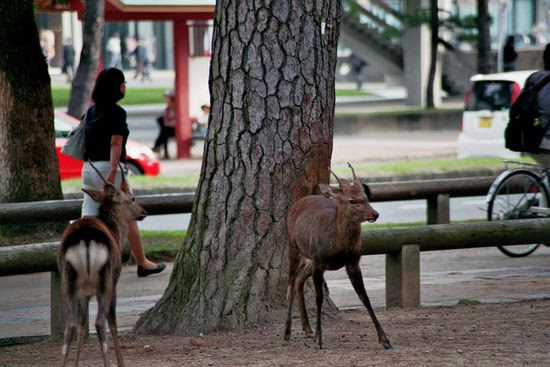
Throughout the city, which is enlivened by the "Deer Park" (modeled on the one in Sarnath) roam freely. The stags, whose rutting calls sound like a badly oiled door, have their horns cut off annually. Generations of feeding them – for which special rice cakes are available for purchase throughout the park – have made the animals docile. Naturally, the entire park is littered with warning signs about injuries these “wild animals” can cause.
I was in Nara for the city’s 1300th anniversary. In addition to numerous other festivities, the first enthronement of the last female empress was celebrated in October – not entirely historically accurate. She first reigned as Koken (749–58), then, after stepping down in favor of her son Jun’nin, whom she quickly removed again as soon as he developed his own ideas, from 764 onward again as Shōtoku († 770) when she had a scandalous relationship with her confessor whose prayers are said to have cured her from some disease. She had granted him ever more privileges and titles. This led to two decisions regarding her successors: Firstly women were excluded from the throne. (Exceptions were Meishō [1624–96, reg. 1629–43] and Go-Sakuramachi-tennō 後桜町天皇, 1740–1813, reg. 1762–71], who remained regent for Kōkaku-tennō) Secondly the capital was moved to Heian (until 1867), modern Kyoto. No temple construction was initially permitted there. This curbed the influence of the clergy.


I have a file on every single one of you … which is why this true blue, model Franconian (cough) has represented the counties Bayreuth and Pegnitz in the European Parliament since 2009. It was of course pure coincidence that the previously little-known chairman of the regional CSU, Theodor zu Guttenberg, who forced through her nomination against the resistance of the local party members, soon after became Federal Minister of Defense. Trying to establish a connection here would certainly be “fake news,” because Guttenberg, as is well known, only falsifies evidence in doctoral theses [Guttenberg had to resign over plagiarism in his], unless he’s busy corrupting young, innocent colleagues like babyface Philipp Amthor [*1992, member of the German parliament since 2017] as a consultant to Kissinger Associates (the consulting firm of the Jewish native Franconian, who was internationally wanted as a war criminal for massacres ordered by him during the Vietnam War and in Chile). All of this is “old news” in Bavarian state politics anyway. In the CSU, it’s not just since the “Amigos” [a term used to refer to a group of corrupt state ministers in the 1990s] that the motto „Wer gut schmiert,der gut fährt!“ [Originally a pre-war advertising slogan for lubricants, roughly translatable as "He who greases [the wheels of government] well, will fare well!"] has been in effect. – who for years disguised herself as incompetent Minister of Culture – gave me a friendly nod in a sushi restaurant (together with her two sons, who during her tenure attended expensive private schools, not the state system she presided over.)It strikes me as somewhat ironic that Masako, the wife of the then heir to the throne, came to Nara for the celebrations. Her sister-in-law finally managed, after several years, to produce a male heir to the throne, after no boy had been born to the imperial family for over forty years in 1967. The problem was exacerbated by postwar legislation that “cleaned up” the imperial family. The root of the problem is that “Heavenly Majesty” Emperor Shōwa, who was disrespectfully called Hirohito by Westerners during his lifetime, had abolished polygamy in the imperial family in 1926. Previously, there had always been a plentiful selection of half-brothers for the succession, even under strict primogeniture and even when the mother was the chambermaid. Something incidentally, was not too rare an occurrence among the Japanese nobility. Such a lady was usually quickly ennobled, or married off to a low-ranking courtier with her aristocratic bastard. Even from Emperor Meiji († 1911), a list, appropriately named “stud book” in English, exists. It records exactly which of his numerous (court) ladies he bonked and when. However, the saying “Sissy stupid fucks well” also applied to the aforementioned Emperor, who ascended to the throne at age 16. His courtiers did not trust him to have the diplomatic savvy necessary to travel abroad to meet his peers. This was at a time when world powers were led by blockheads like Wilhelm II of Germany or the psychotic Victoria.
In light of the crisis over the succession to the throne (1992–2005), the extremely conservative officials of the Imperial Household Agency had already begun to think aloud about whether, if nothing else worked, they should perhaps allow women to succeed to the throne again.4 An anecdote from Masako’s wedding (Incidentally, her grandfather, as CEO of the chemical giant Chisso, was responsible for the Minamata disease cover-up – methylmercury poisoning caused by fish living in untreated sewage in Minamata Bay – and the cover-up of the scandal.) in 1992 illustrates just how reactionary these gentlemen truly are. After the wedding, a daily newspaper published a photo showing the couple – both in Western wedding attire – with her brushing a lock of hair from his forehead. The journalist responsible and his newspaper were banned from the court’s journalists' club, which has a monopoly on reporting, for several weeks because such a human portrayal of a member of the imperial family is inappropriate!
Kōbe
History
Kōbe is a major city in Japan on the island of Honshū. Founded on April 1, 1889, it is the seat of the Hyōgo Prefecture administration and has one of Japan’s largest seaports. This modern, international city forms the heart of the Kansai region, along with Osaka, Kyoto and smaller cities.
Three continental plates (the Eurasian Plate, the Philippine Plate and the Pacific Plate) collide off the east coast of Japan. As in the rest of Japan, the Kōbe area is also home to several seismically active faults. After about 600 years of relative calm in the central Kinki region, an earthquake measuring 7.2 on the Richter scale struck on January 17, 1995, at 5:46 a.m. local time. Because the quake affected not only the city of Kōbe but also the Hanshin region, it is referred to as the Great Hanshin Earthquake. Absolutely no trace remains of the devastating damage caused by the earthquake, which claimed 6,400 lives – after all this is Japan, not Italy.
I went to Kōbe because I’d been told that the library of the local OAG [German East Asia Society] contained some rare works of Hermann Bohner. Although the Japanese wife of the German professor who co-directs the branch there had warmly invited me, after wasting a few days in Nara and its temples, I didn’t arrive until Saturday. Although I probably missed a unique opportunity, I didn’t want to spoil the weekend and limited myself to a visit to Bohner’s grave, the arboretum, Chinatown and the city’s literature museum.
Foreigners' Cemetery
I shall never be able to keep up with the pace of a Japanese tour group (six countries in seven days) … Now the mountain called.

If you want, you could view the Kōbe Foreign Cemetery (Gajin bochi) as a classic example of latent xenophobia among the Japanese. Firstly, it is situated in a beautiful landscape far from the city 8 km and 470 m up the slope of Futabiyama, part of the Rokko massif with its three peaks. Secondly, it is – as the English city map says – “secret.” In concrete terms, this not only means that there is a bus going that way only once an hour on weekends in the summer, but also that, once you have found the entrance which is poorly signposted by Japanese standards, one cannot simply walk in. No, the cemetery is only open to “mourning relatives” Monday to Saturday from 9 a.m. to 4 p.m. After one rings the bell at the gate, a gardener will come and show you to the desired grave. Before you are allowed to leave again, you have to enter your name, degree of relationship and religious affiliation in the visitor’s book.
Kyoto – the ancient capital
Imperial Palace
Kyoto is now a big city like many others, although you’re still not allowed to build anything higher than the tallest pagoda in town. It’s one of the few places in Japan where the checkerboard-style streets have names, but that’s hardly helpful since there are no house numbers. Google Maps is simply overwhelmed here.
Nevertheless, I found the hostel I was looking for. The price couldn’t be beat at € 11 per night, including a “Western breakfast:” that is, two slices of toast with margarine.
After serving as the imperial residence for 1,200 years, but only as the capital until the 13th century, there are numerous buildings to visit. These are all reconstructions, as the city was completely burned down several times during the ten years of the Ōnin War (1467–77). The palaces are, of course, outstanding, including Nijō Castle, the seat of the representative of the Tokugawa shoguns (1600–1867) and the former Imperial Palace.
The latter is only accessible to Japanese visitors after prior written registration, a security check and a waiting period of several months. Foreigners are treated more liberally. Upon presentation of a passport, they receive a ticket for the twice-daily English-language guided tour. However, one is only shown the outside of some of the buildings. A few men in dark suits with buttons in the ear ensure that groups stay on the paths. Today, the palace (actually, there are two) is surrounded by a park that was created after the remaining houses of the courtiers (kuge) were demolished in the late 19th century. One of these buildings still stands and serves as a museum.
It should be remembered that during the Tokugawa period, the emperor and the court nobles were impoverished. The shoguns granted the emperor only 2800 koku of rice (240 liters each6). By comparison a daimyō (provincial ruler) had at least 10,000 koku of unhusked rice a year, while the greatest domains had over a million koku per year. The court nobles from the five houses of the Fujiwara clan, arrogant as they always remained, often had even less. This was also one reason why later-born children were usually sent as quickly as possible to certain temples close to the respective family. An adult needs at least 1½ koku to live, but rice was also a means of payment in the Middle Ages.
Tōfuku-ji and Imperial Palace


Tōfuku-ji
My temple tour continued. Next stop was a major Rinzai Zen training temple. This is the sect that sits facing the center of the hall and meditates on so-called kōan, riddles that cannot be solved logically. That sect is closely associated with the tea ceremony.
In the extensive grounds of Tōfuku-ji, founded in 1236, with its numerous outbuildings, there is almost a sense of tranquility. There are two large gardens to see (admission charges), which are also notable for the fact that large areas are covered with moss (koke) instead of grass. The 15-meter-high Buddha unfortunately burned in 1881. Also noteworthy is the now listed Hyaku-nin benjo, the “Hundred-Man Toilet,” where one can still admire the two rows of pit latrines. This large facility was necessary because Rinzai monks only interrupt their sesshins (meditation sessions) in the nearby main hall for short periods together and then, of course, they all ”have to go” at the same time.
Kingaku-ji: the “golden temple”

Having used up eight rolls of film so far, I pretty much stopped taking photographs. The “golden temple” Kingaku-ji is so impressive, however, that a postcard had to be bought. The building itself is a concrete replica built in 1958, after the original burned down. A particularly sensational feature is an 800-year-old pine tree on display on the grounds – although it now has more supports than branches to hold it upright.
Its counterpart is the “Silver Temple” Gingaku-ji. I skipped that, as well as the Tokugawa Castle. I was “templed out.”

Unpaid advertisement for the best bar in Tokyo: Rock Mother. [shut down ca. 2022]
Then I returned to Tokyo by luxury night bus. The next evening before my return flight, I spent more than just a glass of sake at my old local, Rock Mother. It was still great even after 30 years! It closed in 2022, apparently due to old age of the owner. The branch “Mother’s Ruin” branch was still be open in 2024: Kitazawa, 2-2-7 ヮビル B1.
Curiosities and Food
While it doesn’t really belong in a travelogue, I still feel the need to reinforce or even destroy some clichés about Japan. I hope this will please some of you. Japan isn’t just the land of cherry blossoms, earthquakes and neurotic, dark-suited workaholics. It’s also the land of everyday noise and the obsession with security.
Curiosities: Noise


Constant, exquisitely polite announcements in public spaces constantly warn of supposed dangers (I shall not bother my readers with sound recordings). For example: When you step onto an escalator, a squeaky announcement plays at the bottom of the tape saying something like: Welcome to our escalator, please do not smoke, hold the handrail firmly, but do not extend your fingers over it and do not stand on the yellow lines [at the edge].
Just before you reach the top, a loudspeaker comes along: This escalator is about to end, please be careful not to injure yourself when getting off.
Tofu vendors drive through the streets with honking horns, clothes-racks (used instead of linen), bulky waste collectors (speakers on the car roof), etc. Late in the evening, a man arrives with delicious Satsuma-imo (sweet potatoes, 薩摩芋), which are roasted over an open fire on the back of the pickup truck. (Every time I see this, I wonder if a German police constable could survive that sight without having a seizure.) [As of 2018, all wood fires seemed to have been replaced by gas grills. This spoils the taste.]
It goes without saying that traffic lights have different beeping tones depending on whether they are green or red. Passersbys can hear an Irashaimase (“Welcome”) coming from every shop.
As soon as a garbage truck in Kyoto switches on its left turn signal, it blares: Attention, I intend to turn left. Please be careful. Attention, I intend to turn left. Please be careful. [on a continuous loop]
It goes without saying that every better car immediately emits a penetrating beep (as loud as a burglar alarm in other countries) as soon as reverse gear is engaged. Sometimes, this is accompanied by a squeaky recorded announcement: This car is reversing [on a continuous loop].
In the famous temple gardens, which are supposed to be places of quiet meditation, one school class follows the next. Their noise levels differ only depending on whether the teacher has a megaphone with them or not …
I won’t be going on about announcements on the subway and other public transport, which are repeated between each station (every 1-2 minutes) regarding forgotten umbrellas and the like.
The Japanese word for “noisy” is urusai, which literally translates as “annoying” or “shut up.”
Curiosities: Safety First
安全第一 Ansen dai-ichi. This sign, which is well best into English as “Safety First,” is displayed at every construction site. At larger entrances, such as those in city center parking garages, an elderly gentleman (or sometimes several) wearing a helmet, overalls and a light stick stands to direct traffic. If a pedestrian approaches, with an otherwise completely empty sidewalk and a clear exit, a policeman’s stance is announced and the individual is escorted safely past, sometimes even with a proper 30-degree bow. Four men directed the bus I took from Tokyo to Osaka. It went around the corner on a normal street! Well, these jobs pay hourly wages of 700-800 ¥, rarely more than 1000 ¥ and are a job creation scheme for pensioners who are forced out of the company between the ages of 55 and 60, but have to live on their lump sum of 2-3 years' salary until they reach the government pension, which starts at age 70 and is at the level of German social assistance.

Curiosities: Street cleaning and wastebaskets


Street cleaning or wastebaskets in public? In short: they don’t exist! Everyone sweeps in front of their own door. This is still manageable in the narrow streets of residential areas, but in inner cities and around the huge commuter rail stations, it becomes a problem. Only next to the vending machines are there wastebaskets, with openings cut to the size of cans. Meanwhile, Tokyo has (in residential areas) started hanging nets where the garbage (in plastic bags, not bins) is stacked in the evening for morning collection, to prevent cats and crows from spreading the contents on the street, although they often manage to do so anyway.
An “absolutely brilliant“ idea are the smoking bans. It has simply been banned in public along certain streets. Banned was “smoking while walking” along those busy main roads where no private citizen is stupid enough to sweep. Given the heavy traffic, this measure doesn’t serve to improve the air quality; it just saves the cost of street sweepers and trash cans. Interestingly, the signs embedded in the ground are pretty much the only ones where city governments bother to use foreign languages. The only other ones that are in English are train station signs. It’s probably assumed that foreign scumbags would smoke here, because every "southern barbarian" (南蛮) is ignorant of Japanese virtues and is therefore, by definition, a pig. [People are increasingly adopting the customs of American health moralists: Since July 1, 2019, smoking has been banned in public buildings. In the run-up to the canceled 2020 Olympics, Tokyo banned smoking in bars if employed staff are serving. (Many Japanese pubs are very small and family-run, so they are not affected.)]
Food

First of all: In Japan, you don’t eat, as in Canton, everything with four legs except tables, everything in the air except aeroplanes and everything that swims in the sea except submarines.
However, there are some things that might seem a bit unusual to the average European. There’s no need to worry about getting something inedible, because in front of every restaurant there’s a menu, usually consisting of deceptively real plastic models, or more rarely just photos, of the food being served. See the photos of some of these “menus.” Foreigners never have trouble ordering in Japan because they can always point to the model (outside the door). You don’t eat "on the go" or on the subway; you eat indoors. It’s not a bad idea to bring 1-2 pounds of whole-wheat bread with you to Japan as provisions.
The dark-suited employee (sarariman) at the train station who slurps down a piping-hot bowl of noodles while standing in 90 seconds is proverbial. Slurping is a sign that something tastes good and is considered polite – but woe betide the foreigner who blows his nose at the table.

Nor should one be afraid of unusual spices. There’s hardly any spicy food and garlic is rare (if served it’s Korean-style: plenty of it). However, salt, in the form of soy sauce, is not spared, which may be one reason for the very high rate of stomach cancer. In the past, only two meals, both hot, were customary, in the morning and evening. A "drinks requirement," as is at least morally required in restaurants in Germany, is not found in Japan. Free drinking water or green tea is always available with a standard meal. Tipping is uncommon, although, especially in small family businesses, VAT [since 2018: 10 %] is only added at the checkout.
Some food is simply inedible (mostly imitations of things imported from the West), including:
- Potatoes, grown mainly on Hokkaidō, are almost always the extremely starchy, crumbling variety,
- Cheese “Made in Japan” is nothing more than hardened slices. Dairy products also tend to taste very artificial. Imported cheeses come at a price (well-known European brands cost about 10 times as much).
- Bread (“pan” from the Portuguese) is only available in the American foam-rubber variety, usually with plenty of sugar in the dough. If you squeeze it into a ball and throw it against a wall, it will stick. (Exceptions prove the rule.)

Fish, which is often eaten raw as sashimi or sushi, is always fresh, as the saying goes: Fish that smells of fish is too old.
Top-quality cuts, however, come at a price. Fish counters like those in German department stores, that you can smell them through half the grocery department, are absolutely unimaginable. Genuine sushi has nothing to do with the packaged version that has been available in European supermarkets for several years. Sushi chef is one of the few apprenticeships in the country. The training lasts four years.

Until a few years ago, shops with an alcohol license had a (small) territorial monopoly (usually within a 200-300 meter radius), but in return they had to sell tax stamps, for example. Vending machines (there are nationwide standard prices for soft drinks) are on every corner, but those for beer and sake are becoming rare. They switch off automatically between 11 p.m. and 6 a.m. These machines sell fewer sodas and more flavored teas and – the real hit – cold coffee.
Japanese beer (there are only four national brands) is drinkable and the Yebisu brand is even good. The local firewater is called Shoju, and at 25-30 % Alc., while not overly strong, is guaranteed to give you a headache the next morning and is really only suitable for mixed drinks. The more well-known is sake, a “rice wine” with 13-15 % Alc. is in fact brewed. It retails in handy 1.8-liter bottles and, if the quality is decent, goes down like water. It’s served (usually warm) in small bottles (1 go = 180 ml). Better qualities can also be drunk cold.
The real thrill of Japanese food is the pufferfish, fugu (from the family Tetraodontidae). Pufferfish can inflate into a spherical shape by absorbing air or water into an air sac, which acts as a deterrent to some predators. Despite their toxicity – tetrodotoxin – they are eaten in Japan after careful preparation. The toxin is located in the gallbladder, which must not be damaged during slicing. Only specially trained and licensed chefs are allowed to prepare Fugu. Nevertheless, several Japanese die (The amount of poison contained in a single fish would be enough to kill up to 30 people. The Tokyo Health Department recorded one death in its jurisdiction from 1993 to 2011, caused by fugu eaten in a restaurant. Nationwide, an average of 44 people died per year in the 1980s. Since 2010, the number has been between zero and six per year. Considering 2014 as the worst year, there were 11 deaths nationwide and 359 non-fatal poisonings treated in hospital.) every year after eating. These are either suicides or amateurs who have butchered fish they caught themselves.
Of course, there are also some things that seem a bit unusual to us; I'll let the clickable images do the talking:


Norway, Iceland and Japan are the only three countries in the world that still practice commercial whaling. From 1986 to 2018, Japan limited its catch to 1,000 minke whales (2-3 tons per animal) annually ”for research purposes.” Anyone can then try it out in a department store to see what it tastes like (red whale meat is quite unpopular because the inferior, strong-smelling varieties were often served as school meals in the 1950s and 1960s). In the first two years after the ban was lifted, the Ministry set a quota of 383 animals in Japanese coastal waters, which was not fully utilized. It turned out that the meat sold poorly at prices around 3,000-4,000 ¥ per kg and most of it ended frozen in storage.
In Taiji, Wakayama Prefecture, local fishermen hunt dolphins from October to February. Around 1,500 are killed annually. The boats operate in groups, driving the mammals, which live in swarms, onto the beach in a sort of hunt, where they are slaughtered by the waiting villagers. [The documentary The Cove won an Oscar in 2009.]
Some animals are also caught alive; in 2020, 90 were caught, which were sold at a price of 5 million ¥ each, primarily to Chinese water parks. A dead dolphin is worth about 50,000 ¥ and the meat sells for 2,000 ¥/kg in stores.


–
Addendum: Trip 2018
I visited Japan again in September 2018. There’s no actual travel report for this stay, just galleries of places visited. You can find captions of the images by clicking on them to enlarge them.

Kamakura
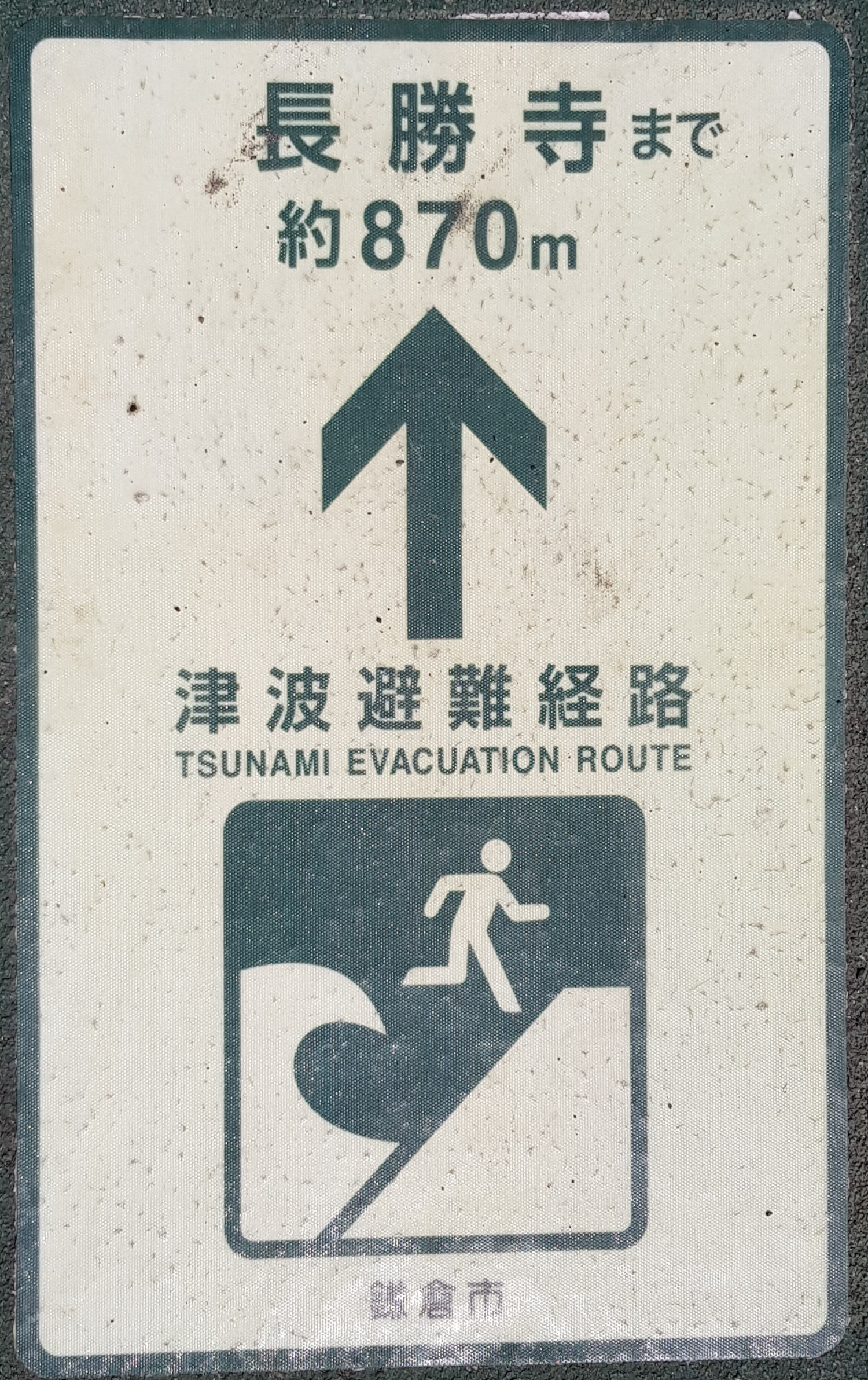
In the Middle Ages, Kamakura (鎌倉市) was the seat of the shogunate until, after civil wars, the center of power was relocated to Kyoto in 1333. Situated on the seafront, it is a recreation area for Tokyoites; there are also numerous ancient temples and the famous "Great Buddha" (Daibutsu) to visit. Japanese tourists appreciate the view of the rocky island of Enoshima.
Temples of Kamakura



Hakone

Hakone am Ashi-See entwickelte sich schon bald nach der Öffnung Japans zu einer beliebten Sommerfrische für die europäischen Kaufleute, wie man unten auf der Ausnahme, die ca. 1890 entstand sieht. Seit Jahrzehnten ist die ganze Region touristisch vollkommen duchstrukturiert. Aus Tokyo braucht man nur 1½ Stunden. Am Berg 2015–6 war das Tal Ōwakudani, berühmt für seine in Schwefeldampf gegarten Eier, wegen zu hohem Giftgasanteil nach einem Vulkanausbruch gesperrt, was jederzeit wieder geschehen kann. An Kunsthandwerk pflegt man Intarsienarbeiten von verschachtelt zu öffnenden Holzkästchen (寄木細工, yosegi saiku).


Open Air Kunstmuseum in Hakone-Gora (彫刻の森美術館)


Nikkō
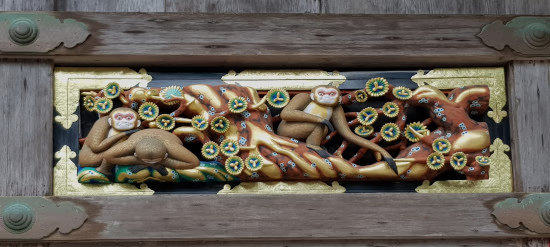
Near the city of Nikkō, Tokugawa Ieyasu had his shrine-mausoleum built, which exudes a baroque splendor unusual in Japan. The world heritage was completely renovated in 2009–22.




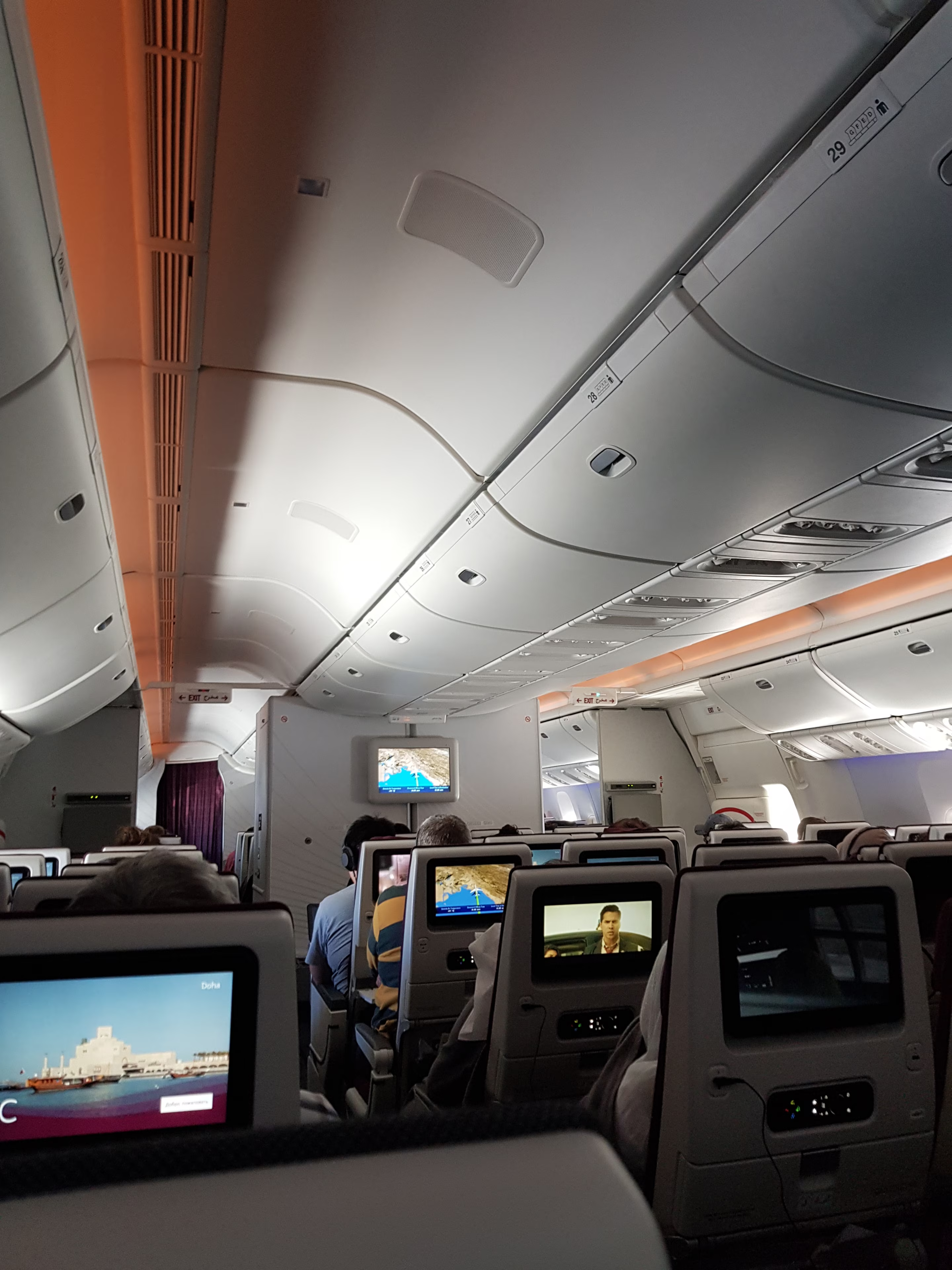
To and fro with Qatar Air
Quatar Air